 Skip navigation
  Previous Page


training. “I was excited, but also terrified,” she recalls, “because you’ve studied these ideas for so long, and thought about them in such depth – and then you’re sitting in front of somebody and actually interact with them in a genuine way.”
Like Cassin, she quickly became aware of the sheer variety of clients that pass through the clinic – often with multiple problems and concerns. “You’re working with people who are, for example, not only depressed, but also homeless; a client who is very anxious, but is also HIV-positive, and maybe English isn’t their first language. There are a lot of different factors at play that you’re learning to navigate.”
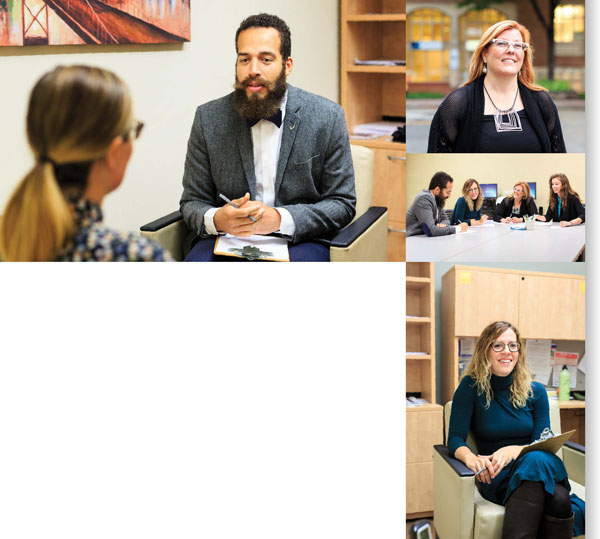
One distinguishing feature of the practicum is that it takes place physically within a hospital setting, Cassin says. “I think our program is one-of-a-kind. They [the students] are seeing real clients and they get supervised by faculty members within the program, which is unique for a lot of clinical psychology programs.” As well, students have the option of videotaping sessions with clients – if the client consents – allowing their clinical supervisor at Ryerson to offer detailed feedback. “The environment really fosters collaboration,” Cassin says.
Of course, other universities train psychologists – but many graduate programs either don’t have an in-house practicum program (so that students must do their practicum training at another institution, with external supervisors); or, if they take place within the university, the students provide treatment to people recruited from the university or community or they may not see real patients (that is, they see “faux patients” recruited for the program to take part in mock interviews).
Ryerson students also benefit from having St. Mike’s staff members by their side – or, at most, a call, email, or instant message away. “At first the students might be a bit cautious – not wanting to bother the doctors, for example,” says Horner. “But they come out of this amazed at how approachable they are, and how interactive and intertwined the care is.”
As Horner explains, the patients’ records are completely electronic, and the students can share and collaborate on patient information with doctors and other professionals at the clinic instantly.
That instant access to expertise was something that also stood out for Andrew Brankley, a third-year PhD student who did his practicum at the clinic in 2013-14. Specializing in forensic psychology, which includes working with the criminal justice system (the clients he sees have often been in contact with the police or the courts), Brankley is now working part-time at the clinic, passing some of that knowledge on to a fresh cohort of students. At St. Mike’s, 
18 Ryerson University Magazine • WINTER 2017
