 Skip navigation
  Previous Page


A practical garden project
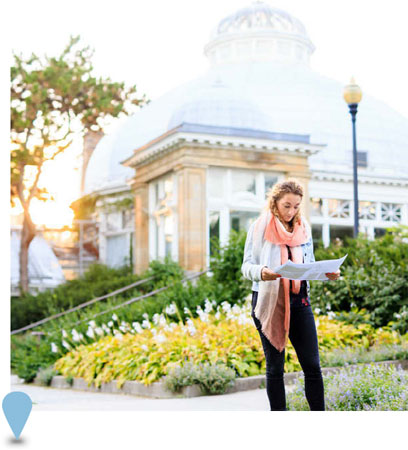
Allan Gardens, with its iconic greenhouse, is a familiar site to Ryerson students – a small green oasis in the heart of downtown Toronto’s concrete jungle (and just a few blocks from campus). What passersby might easily miss, however, is a unique community garden located just behind the greenhouse itself. Known as the Edible Allan Gardens Project, it was designed and built by Ryerson graduate students in collaboration with 10 community partner groups; it opened in June 2016.
Ashley Adams, a 2016 graduate of Ryerson’s architectural science program, was asked to oversee and design the project – and she leaped at the challenge. While the greenhouse itself is a beautiful structure, she says, “the fenced-in space didn’t mirror that beauty.” Their goal, she says, was to create something both beautiful and beneficial to the community, a “demonstration garden” that community groups could use to learn and practice urban agriculture.
The final design employed raised bed containers that could be easily moved if needed, as well as “gabion baskets” – rectangular containers that can serve either as soil-beds or, if filled with heavier material, as benches or tables.
“We used a lot of recycled materials,” Adams explains. “Everything from wine bottles, concrete blocks, hay, random bricks that we found” – anything that would give the baskets structural support.
Along with the design issues were the challenges of trying to please a wide array of potential users. “People wanted different things,” Adams says. “There was a lot of compromise with the various groups, to try to make everyone happy. But that was the fun part, trying to figure that out.”
While working on the project, Adams got to know some of the staff at ERA architects, a firm specializing in heritage conservation and restoration and one of the partners in the project. Later, she landed a job with the firm. ERA is drawn to grads who have more than just schoolwork on their resumé, Adams says, “so I think that they also appreciated this unique experience.”
“The clinic feels like halfclassroom, half-hospital… It very much is a hospital, but it’s also very much a learning environment.”
— ANDREW BRANKLEY
he says, he’s completely comfortable approaching a professional, whether it’s a social worker or a chiropractor or some other specialist, and asking for advice. “They’re very open, they walk you through things,” he says. The clinic “feels like half-classroom, half-hospital… It very much is a hospital, but it’s also very much a learning environment.”
As well as being a unique opportunity for the students, the clinic provides much-needed care for its clientele. Some 135 patients are treated at the clinic every year, with some 110 assessments annually. And unlike the vast majority of psychology treatments available, there is no out-of-pocket cost to the clients. “We provide assessments and treatments to people who typically wouldn’t receive them,” says Cassin. Similar treatment at a private clinic might cost around $200 per hour, she says; plus, often hospital-based psychology services have long waiting lists. Because the clinic is part of the St. Mike’s family health unit, anyone receiving treatment there is eligible for treatment at the Psychology Training Clinic.
“I think it’s mutually beneficial,” says Cassin, “because these clients are receiving services, and our students are receiving outstanding training and opportunity to work with real clients very early on, as part of their education.” 
DAN FALK (@DANFALK) IS A SCIENCE JOURNALIST BASED IN TORONTO. HIS BOOKS INCLUDE THE SCIENCE OF SHAKESPEARE AND IN SEARCH OF TIME.
20 Ryerson University Magazine • WINTER 2017
