 Skip navigation
  Previous Page


GIVING BACK
ALUMNI AND FRIENDS GIVE GENEROUSLY TO HELP STUDENTS SUCCEED
Transformation through education
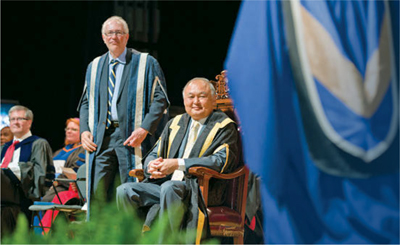
As chancellor of Ryerson University, the late business leader and philanthropist G. Raymond Chang participated in 95 convocations and awarded nearly 30,000 degrees and diplomas. For the man known as “the students’ chancellor,” celebrating their accomplishments was one of his favourite things.
Before he was chancellor, Chang was an entrepreneur, helping transform a small Toronto mutual fund company into an international investment titan that today manages more than $140 billion. Chang shared in the excitement as Ryerson took the entrepreneurship agenda to new heights, giving it early expression in the DMZ startup incubation space.
Chang’s daughter, Brigette Chang-Addorisio, once asked her father why he was so involved with Ryerson. “He said he looked for the potential for transformation,” she recalls, “and Ryerson allowed people to gain their education in a flexible way – over years. He wanted to support people’s ability to better themselves and their family’s position through education.”
Now, Brigette and her brother, Andrew Chang, are furthering their father’s legacy, and honouring his friendship with past-president Sheldon Levy, with a $250,000 gift to support two new student awards: the G. Raymond Chang – Sheldon Levy Partnership Award for Zone Learning; and the G. Raymond Chang Award in Continuing Education.
The siblings created the award to help students in zone learning – Ryerson’s unique business development ecosystem.
“Ray was – and we are – supporters of entrepreneurship,” says Andrew. “We want to help people get the knowledge and skills and all they need to learn to run a business.”
They also wanted to recognize the way their father valued lifelong learning. Creating a bursary at The G. Raymond Chang School of Continuing Education is, says Andrew, “a way to continue his work.”
“Ryerson was a big part of his life,” says Brigette. “He was confident that these programs could help a lot of people. Andrew and I wanted to put something together to honour that.” 
BUILDING BLOCKS OF SUCCESS
Yabu Pushelberg founders George Yabu, Interior Design ’76, and Glen Pushelberg, Interior Design ’76, created the Yabu Pushelberg Award for Innovation in Interior Design to support burgeoning entrepreneurs in the Design Fabrication Zone (DFZ) – Ryerson’s interdisciplinary incubator for emerging designers, architects and engineers to take design projects from idea to prototype. Their gift – matched by the university and the Brookfield Institute for Innovation + Entrepreneurship – created an annual award of up to $6,000 for a student at work in the DFZ.
A Faculty of Communication & Design graduate, Jessica Lee, Interior Design ’15, was the inaugural recipient of the award. Her design project is a system of magnetized self-assembling polygonal cubes that can link together to form original structures (or repair existing ones) by programming and activating the buildingblocks from a static state.
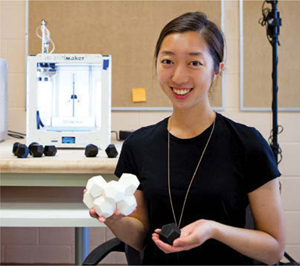
“Think magnetic Lego, except the geometry lends itself to infinite tiling options in every direction,” says Lee. “I don’t have a defined application at this time – that’s one of the things I am working on at the DFZ – but the nature of the blocks allows for a wide range of uses.”
With the award, Lee is able to purchase the materials she needs – epoxy, resin and “lots of magnets” – to complete a small-scale prototype that will demonstrate how the system works. She uses 3D printers in the DFZ to produce test modules.
“Before the award, this was a thesis project,” says Lee. “The funding from Yabu Pushelberg brings it out of the classroom and into the real world.”
34 Ryerson University Magazine • WINTER 2017
