 Skip navigation
  Previous Page


SCIENCE FICTION
WOULD HAVE US BELIEVE ROBOTS are taking over the world. That there is a suspicious breed of androids secretly watching our every move, poised to take our jobs.
But Ryerson researchers are shattering that version of science fiction by finding inventive ways to use robots for the good of society.
History professor Jean Li spent several weeks last summer in Egypt investigating el-Hibeh, a 3,000-year-old city three hours south of Cairo that was founded at the turn of the first millennium BC. About two square kilometres in size, the site boasts a once-impressive town wall enclosing an ancient settlement with desert cemeteries. Since it was first discovered, the site has been affected by age, erosion and looting.
It’s unsafe and inadvisable for humans to enter the underground tunnels at el-Hibeh, so Li turned to modern technology to investigate ancient Egyptian history. To get a look at what lies beneath the surface, Li took with her a six-wheel metal robot designed to traverse rough terrain and sandy depths. It was designed in collaboration with Alexander Ferworn, computer science professor and program director of the master of digital media (MDM) program.
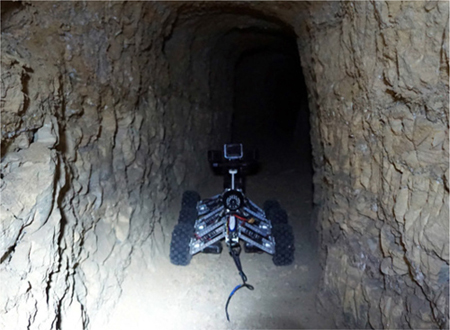
Mounted with a GoPro camera, the robot travelled underground as deep as 27 metres in one tunnel, while relaying information back to Li and the team, which included digital archeology specialists Namir Ahmed, co-ordinator of the Library’s Isaac Olowolafe Jr. Digital Media Experience Lab, and creative industries professor Michael Carter.
“Overall it was a successful mission,” Li said. “The robot was deployed six times over four days and helped us assess the environment. There’s nothing that can replace the human experience of going through a site, but this is the first step in learning about the site. The robot was meant to be a tool, not to replace the human archeological element.
“This is all in the spirit of exploration. The site at one time was a town where people lived, loved and died. They have left behind signs of their life and we’re rounding out a picture of the past that seems so removed from modern society. It helps us figure out how we got here.”
Transdisciplinary collaboration was a crucial part of the project. Students from Ferworn’s MDM program, along with computer science undergraduates, constructed six robot prototypes. MDM graduate Rob Blain and computer science PhD candidate Jimmy Tran contributed to the final robot prototype that went to Egypt. Blain, along with MDM alumnus Kristian Howald, also redesigned the el-Hibeh website and designed the new virtual reality reconstruction of the el-Hibeh temple. A team of graduate students from the University of California Berkeley, a research partner, assisted Li in Egypt.
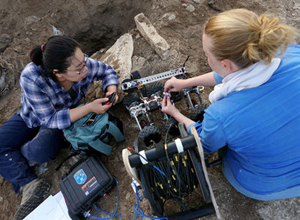
“THE ROBOT WAS ALWAYS MEANT TO BE A TOOL, NOT TO REPLACE THE HUMAN ARCHEOLOGICAL ELEMENT,” LI SAID.
The project was funded through an interdisciplinary grant from the Office of the Provost and Vice-President, Academic, along with funding from the Faculties of Science and Arts, Yeates School of Graduate Studies, the Department of Computer Science, Chang School of Continuing Education and the Library.
For Ferworn, the collaboration was an important part of informing his work as a roboticist interested in public safety.
“Most of my research involves public safety; robotics is a part of that,” he said. “Without the cross-disciplinary collaboration, we couldn’t expand knowledge. I’m a big believer in it. Robotics can expand the tools available to archeologists and help keep people safe in difficult working environments.”

FOR FRAUKE ZELLER, a professor in the School of Professional Communication, robotics has become about culture, a way to study a more formal relationship with robots.
