 Skip navigation
  Previous Page


Zeller and her research partner David Harris Smith, a professor in the Department of Communication Studies and Multimedia at McMaster University, first made headlines in 2014 with hitchBOT, a friendly, hitchhiking robot that travelled more than 10,000 kilometres across Canada. Twisting the science fiction perception of robots, this research project explored whether robots can trust humans by relying on their kindness to help with hitchBOT’s travels.
Zeller’s current research looks at exchanging health information using a state-of-the-art human-robot interaction system. She is partnering with Smith and Hermenio Lima, a dermatologist and professor of medicine at McMaster’s Michael G. DeGroote School of Medicine.
The team is using Softbank’s humanoid robot Pepper to improve health care outcomes between health professionals and patients. Programmed with IBM Bluemix Watson Cognitive Services, Pepper is meant to interact with people, “read” emotions, learn, move and adapt to its environment, and even recharge on its own.
The project, funded by SOSCIP (Southern Ontario Smart Computing Innovation Platform), the Ryerson Health Fund and seed funding from the Faculty of Communication & Design, is still in the early stages. Pepper is being programmed and tested for its AI capabilities but the premise is that humans will be more open and honest with Pepper about their health.
“It was Hermenio’s brainchild to merge artificial intelligence and social interaction for health care,” Zeller said. “This is about cultural robotics. It’s not meant to replace doctors or nurses but is about how can we amend or expand services.
“Using Pepper in a clinical setting will reveal how people talk in different professions. The hope is that a robot gets people more chatty and gets them inclined to do something about their health.”

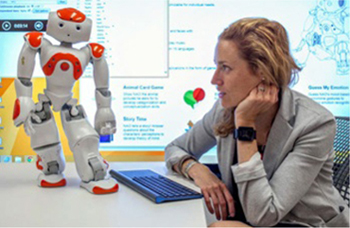
SIMILARLY, STÉPHANIE Walsh Matthews, a professor of languages, literatures and cultures, uses Pepper’s “big sister,” NAO, another humanoid robot from Softbank, to practice language with children who have autism. The goal is to unlock some of the mysteries behind autism spectrum disorder (ASD).
“Robots are very predictable,” Matthews said. “They’re neat, have no mannerisms, the parameters are set. Interacting with robots allows children with ASD to practice interaction – what they practice here can be used in human interaction as well.”
Funded by two Social Sciences and Humanities Research Council institutional grants from Ryerson, Matthews co-investigates with Jamin Pelkey, a fellow professor in languages, literatures and cultures. Sessions are typically 45 minutes long and Matthews observes in the background while a therapist works with NAO and the child on various activities. The session is audio recorded and transcribed to reveal any speech data and behaviour.
“Working with robots is a tool but really an opportunity for interdisciplinary relationships,” Matthews said. “But it only works if everyone is on one team. We have to be really clear because we don’t all share the same jargon. Communication makes all this possible.” 

WELCOME TO THE FUTURE
By Mark Witten
The Brookfield Institute for Innovation + Entrepreneurship (BII+E) was established at Ryerson University in 2016 to help make Canada the best place to be an innovator or an entrepreneur. “We saw the need to create an institute that looks at the economic and public policy implications of how to support innovation, and to focus on what the country should be doing to embrace an innovation-driven economy,” says executive director Sean Mullin.
The Brookfield Institute identified robotics and automation as a vital, transformational issue that will have a huge impact on jobs, young Canadians and our different regional economies over the next 10 to 20 years. The first of the institute’s three reports on these impacts, The Talented Mr. Robot, found that nearly 42 per cent of jobs in Canada are at high risk of being eliminated or significantly changed by robotics and automation.
The positive side is that robots in the workplace will create a greater number of potential new job opportunities. “Occupations with the lowest risk of being affected by automation are projected to produce more than 700,000 net new jobs over the next decade,” says Mullin. “The ability to use technology and problem-solve with technology will be increasingly of value. Jobs that require creativity and judgment, where human interaction skills are essential, like nursing, teaching and managing other people, have high resilience and will be in demand in the future.”
The Brookfield Institute was made possible by the vision of former Ryerson University President Sheldon Levy and Jack Cockwell, who along with the Brookfield Partners Foundation, provided $16 million in funding to seed the institute.
“The initial funding has been integral to our success in tackling important issues, like the impact of robotics on our workforce, and helping shape Canada’s economic policy,” says Mullin.
