 Skip navigation
  Previous Page


GIVING BACK
44
Hours of work that a $500 bursary could save a Seneca student earning minimum wage.
“Collaborating with Seneca was a natural fit given their proficiency and expertise in this area and the positive impact findings can have on welding projects globally.”
A deep dive in search of a better weld
CWA Foundation
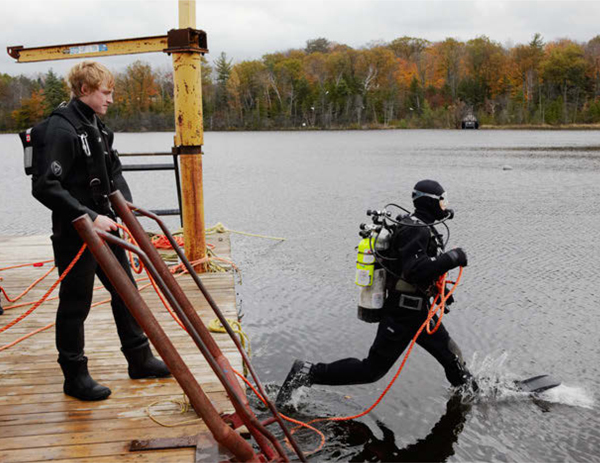
STUDENTS IN SENECA’S Underwater Skills (UWS) program, based at King Campus, receive training relating to commercial diving, welding, construction, inspection, repair and salvage work. Their unique training leads them to rivers, lakes and canals around the world, in both the offshore oil and onshore construction sectors of the diving industry.
There are few programs like these in Canada, and graduates are in hot demand, as is the knowledge that UWS faculty and students can provide through research.
Recently, the UWS commercial diver training program entered into an applied research partnership with the Canadian Welding Association (CWA). The focus is a promising new “Temper Weave” underwater welding technique to create higher grade welds than are currently possible for structures completely submerged underwater.
Foundation funds will help Seneca conduct research to attempt developing an underwater welding procedure that will produce wet welds of the same quality and consistency as dry welds. The funds will be used to purchase specialized materials and equipment, including low carbon steel for simulation welds. Based on the results of the initial research, the CWA Foundation has also committed additional funds in the coming years.
“This research will contribute significantly to how our industry approaches underwater welding,” says Deborah Mates, Director, CWA Foundation. “Collaborating with Seneca was a natural fit, given their proficiency and expertise in this area and the positive impact findings can have on welding projects globally.”
Research will be led by Seneca Professor Mike Borean, who says that people don’t generally think about how difficult and complex it is to fuse metals together “in the wet.” Yet, if it can be done consistently, with high quality results, the impact would be significant.
“To configure a dry chamber or habitat surrounding a structure submerged underwater is a large, costly task,” says Mike. “This is an opportunity for time and cost savings across many underwater welding applications.”
Thanks to the water-based resources at King Campus, including Lake Seneca and the 40-foot-deep indoor dive tank, Seneca is well positioned with the infrastructure, equipment and expertise to conduct this kind of research. It is scheduled to get underway this fall.
Learn more about Seneca’s UWS program: senecacollege.ca/fulltime/UWS
